
Takes 30 seconds. We call you back to set a time.
Every photo here is from our own work, with our logo on it.
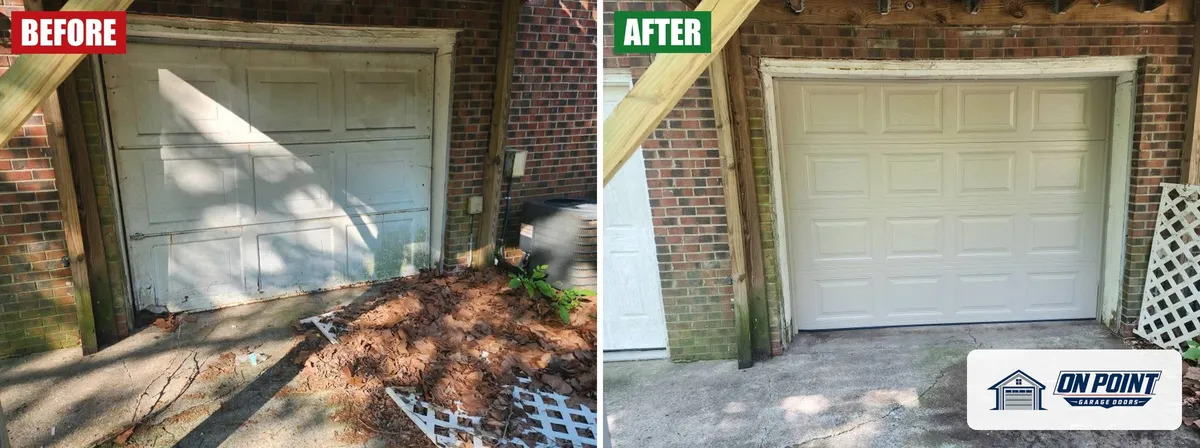
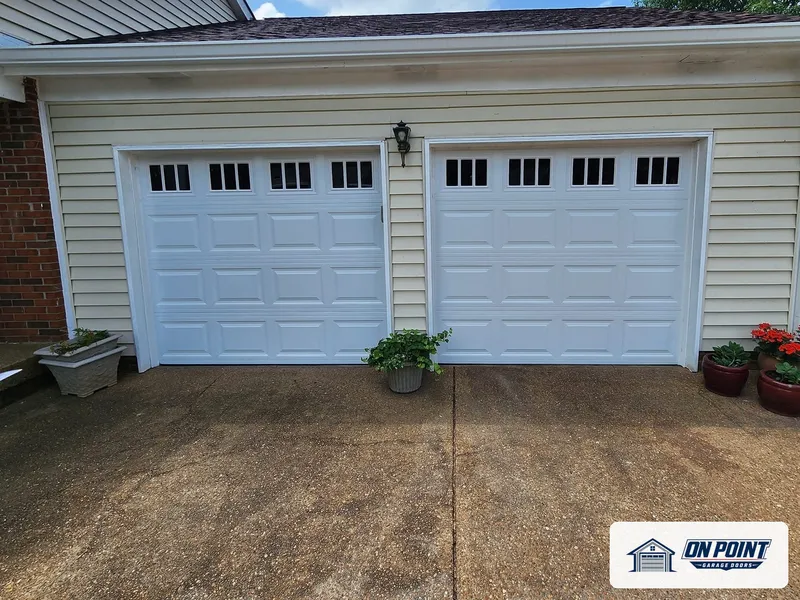
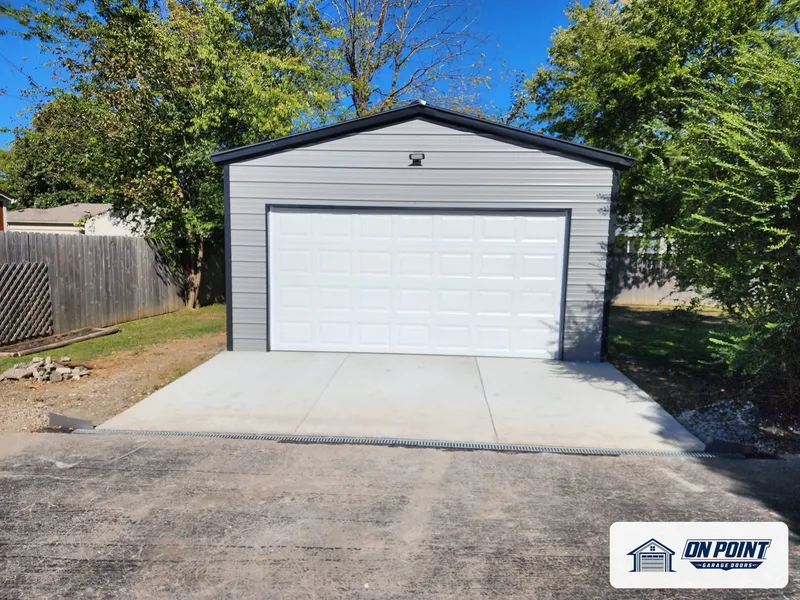
A carriage-house door gives a garage the look of the old swing-out barn doors while it opens overhead like any other door, and real wood or a good woodgrain makes it warmer still. OnPoint Pro Doors helps homeowners across metro Atlanta weigh real wood against wood-look steel and composite, then measures, hangs and balances the door. The estimate is free.
Behind the look, a carriage-house door is an ordinary sectional door that rolls up into the garage. The style is in the face: vertical boards or grooves, an X or a Z in the lower half, overlays that suggest two doors meeting in the middle, decorative handles and strap hinges that don't actually swing anything, and often a row of square or arched windows across the top.
Done well, it gives a brick-front house or a craftsman-style home the garage it looks like it should have had. Done badly, with a pattern that fights the house, it reads as a costume. That is why the style is chosen standing in front of the house, not from a brochure.
Real wood doors are usually built from cedar, redwood or a paint-grade species, and nothing else has quite the depth of real grain. They also move. Humidity swells the boards in summer, dry winter air shrinks them, and a door facing the afternoon sun bakes its finish faster than one on the shady side of the house.
So a wood door lives on its finish. It has to be sealed or painted when it goes in and refinished every few years after, and the bottom edge needs the most attention because that is where rain splashes and leaves collect. If that upkeep sounds like a pleasure rather than a chore, wood is worth it. If not, the next section is the honest alternative.
The style that suits one street looks wrong on the next. An intown bungalow with tapered porch columns usually wants a simple carriage pattern with square windows and plain hardware, while a two-story brick home in the suburbs can carry a bolder overlay and arched glass across the top.
On a house with a pair of single doors, both are done in the same pattern so they read as a matched set. On a wide double door, the pattern is laid out so the center of the design lines up with the center of the house, which is the detail people notice without knowing why.
Steel doors now come with a woodgrain finish that reads as stained wood from the curb, and composite skins go further, taking texture and a finish that resembles a real stain. Both shrug off humidity, neither rots, and both can carry the same carriage overlays, handles and window patterns as a wood door.
With an insulated core, these doors are also quieter and keep a garage noticeably cooler, which matters when there is a bonus room or a home office over it. They need washing rather than refinishing, and the finish is chosen from samples held against the brick in daylight.
A carriage door is ordered to the house, so the order of steps matters.
Wood doors and composite doors with a thick core can be much heavier than the plain steel door they replace. The springs are chosen for the new door's weight, never carried over from the old one, because a heavy door on light springs makes the opener do the lifting and wears it out early.
If the existing opener is older or already working hard, a stronger unit is suggested alongside the door, with a belt drive where someone sleeps above the garage. Wide two-car carriage doors also get reinforcing struts across their sections, which keep a heavy face from sagging over the years.
Many subdivisions around the metro spell out which garage door styles and colors are allowed, and some townhome communities specify one design for the whole row. A carriage door can fit those rules well, but the approval comes first.
The door's spec sheet and a photo of the chosen finish are provided for the application, and nothing is ordered until the association has signed off. On a townhome row the new door is matched to the approved look so it doesn't stand out from its neighbors.
A wood door's finish slowly gives way to sun and rain, and the signs are easy to see: a dull or chalky surface, gray wood showing at the bottom edge, or boards starting to check. Refinishing at that stage keeps the wood sound; waiting until it is soft at the bottom means a section repair.
Woodgrain steel and composite doors age far more slowly, and the decorative hardware is made for the weather. Either way, the moving parts behind the face are what keep the door running, and those are covered on our garage door maintenance page.
It can be, as long as the finish is kept up. Wood swells and shrinks with the seasons and needs refinishing every few years. Woodgrain steel or composite gives the look without that upkeep.
It is a sectional door styled to look like a pair of old swing-out doors, with overlays, decorative handles and hinges, and often windows across the top. It still opens overhead.
Over many years in full sun, some fading is normal. Lighter finishes and doors on the shady side of the house hold their color longest, and the samples are judged against the house in daylight.
Usually, and sometimes by a lot. The springs are sized to the new door, and the opener is checked to make sure it can handle the weight comfortably.
Yes. The door color, the hardware finish and the window pattern are chosen together, with samples held up against the trim and the brick in daylight before anything is ordered.
Yes. Square or arched windows across the top section are common, with textured glass where privacy from the street matters.
Many communities allow them, and some prefer them. The spec sheet is provided for the application and nothing is ordered until it is approved.
Often, if it is in good shape and the door is balanced. If it is older or already straining, a stronger opener is suggested alongside the door, and the choice is yours.
Yes. The house is looked at, the options are explained, and the free estimate comes before any order.
Explain what the door is doing and we'll say, honestly, whether today is necessary. Free estimate wherever you are.
Rather say it out loud? Call (770) 629-9647.
Tell us what's happening. Free estimate, nothing owed.