
Takes 30 seconds. We call you back to set a time.
Every photo here is from our own work, with our logo on it.
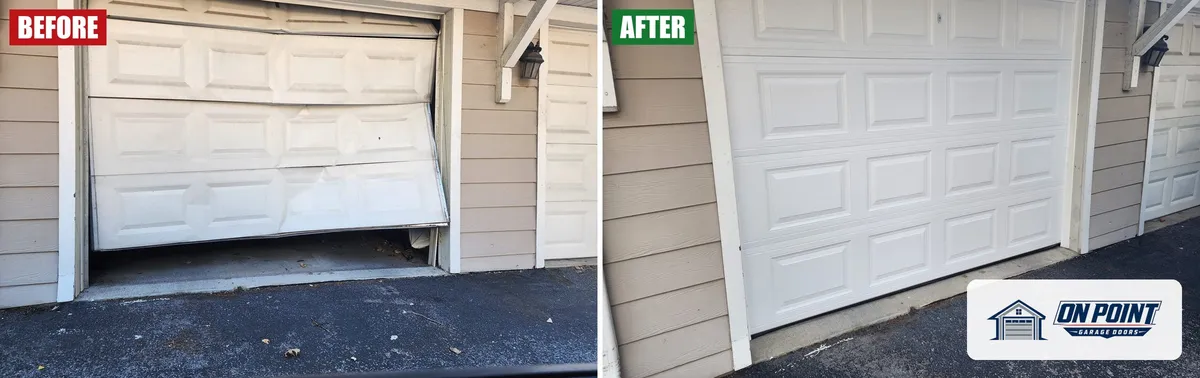
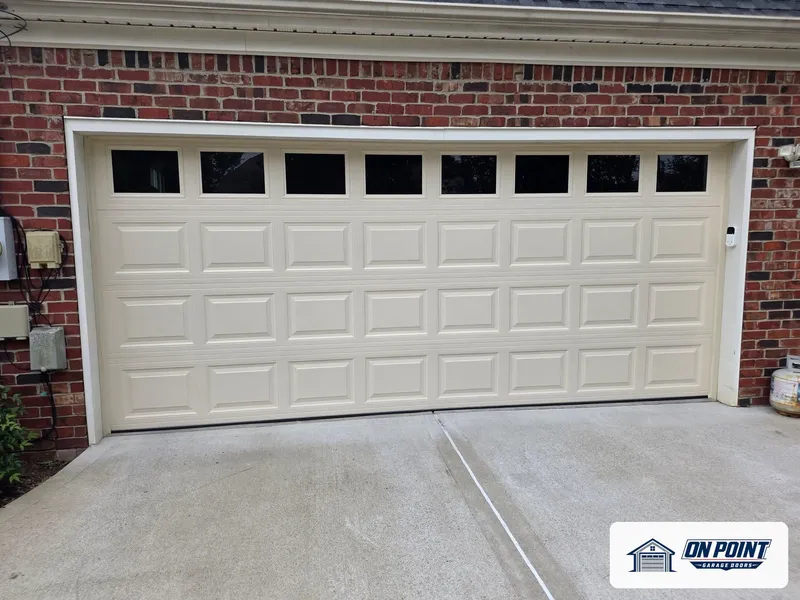
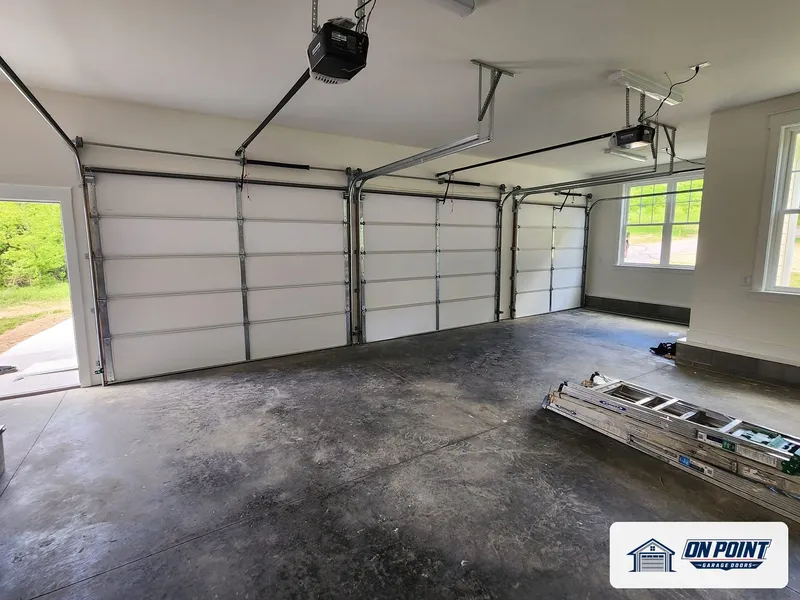
Driveway gates that stall, drag, hum or stand open, and the operators, keypads, loops and sensors behind them. Most are back in service after one visit, and estimates are free.
A gate that won't open strands a car; one that won't close leaves the property open to the street. We work on powered swing gates hung on linear or articulated arms, sliding gates riding a ground track or cantilever rollers, and every operator and control that moves them.
In the northern suburbs that usually means ornamental aluminum or steel at the end of a long drive, with a keypad at the curb and an intercom up at the house. Intown it's more often a slider across a narrow drive or a courtyard gate beside a townhome.
Whatever the setup, the first look goes to the gate itself, because a gate that binds will ruin any operator bolted to it.
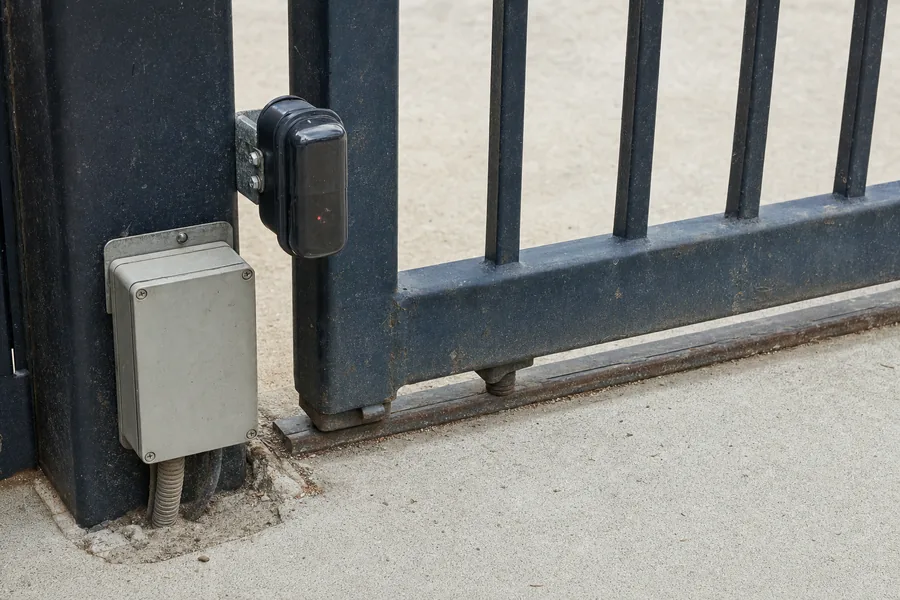
An automatic gate has more ways to quit than a garage door. The ones we see most:
Operators are rated for gates that move freely. Once hinges wear, posts lean or rollers seize, the operator fights the gate on every cycle; the force setting creeps upward, safety reversing gets less sensitive, and the motor and gearbox wear out early. The heavier the leaf, the faster that damage builds.
So the operator cover stays on at first. The arm is released, the gate is moved by hand, and hinges, posts, rollers and track all get checked. A gate that swings or slides easily is ready for its operator; one that doesn't needs attention before anything else.
Georgia's red clay plays a big part. It swells after rain and shrinks in a dry spell, and posts set in it can lean further each year until a gate that once hung true starts dragging.
A gate stands out in Georgia weather all year. Humidity rusts hinges, chains and brackets; heat wears down batteries and capacitors; thunderstorms bring surges, falling limbs and debris in the tracks.
Pine limbs are the local specialty: a summer storm drops one across a slider's track or onto a swing leaf, bending the leaf or knocking the limits out.
Heat inside a dark operator housing in August wears batteries out well ahead of schedule.
The ground moves as much as the weather does. Loops cut into a driveway crack as the slab settles, and posts set shallow shift with the seasons.
Fire ants belong on this list too. They're drawn to the warmth inside operator housings and control boxes, and a colony packed across a circuit board can short it. Sealing the openings is part of the repair.
Most gate repairs finish in one visit, because the parts that fail are the parts the truck carries.
Plenty of calls that begin as a broken gate end as a broken control: a keypad whose board has failed, a receiver that lost its codes, an intercom that no longer rings the house, or a loop that quit sensing cars. Shared gates with long code lists get the old codes cleared.
Safety devices are part of that work. A gate that closes onto a car or a child isn't an inconvenience, so eyes and edges are always repaired and never bypassed.
Where a gate crosses a sidewalk or sits beside a play area, the technician checks that the entrapment protection covers every pinch point, not just the center of the opening.
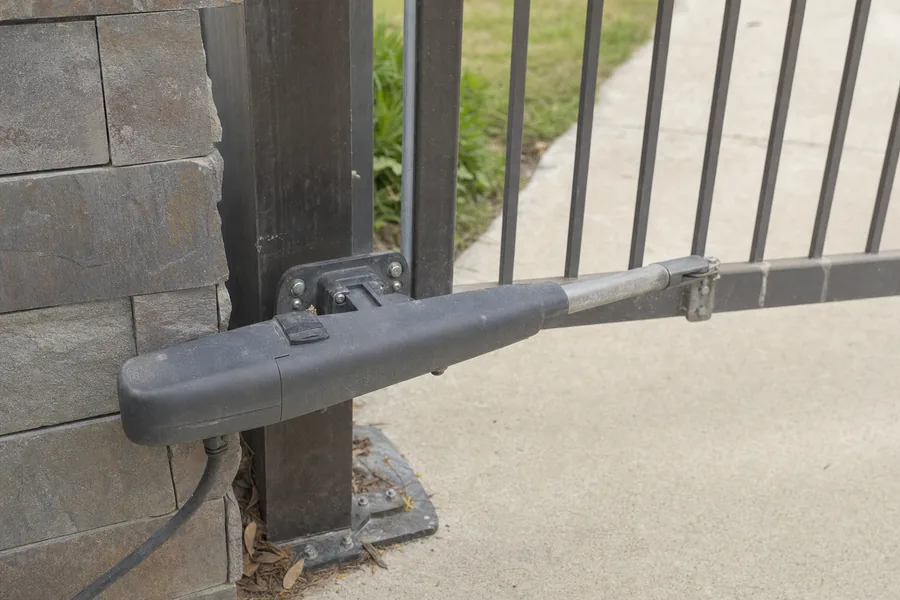
Most operators deserve another run. A board, a battery, reset limits, a new arm or chain generally buys years. Operators rarely fail all at once; one part gives out and the rest carry on.
When a replacement is warranted, it's sized to the gate's actual weight and length, and it goes up only after the gate moves freely by hand.
Solar is an option where trenching power isn't practical, though under the heavy tree canopy in older neighborhoods a panel needs a spot that stays in sun as the trees grow.
Gates we service run on Ghost Controls, GTO, FAAC, Elite, Linear, DoorKing, Viking, Nice and Apollo, Mighty Mule, LiftMaster and others, and common parts ride along. If yours isn't listed, a photo of the operator's label lets us check parts before the visit.
Let us know whether any light shows on the operator, whether it's solar or wired, whether it hums or stays quiet, and whether a storm came through right before it stopped. That tells us what to load.
Please don't shove a gate that's still attached to its arm. That bends the arm, strips gears and can tear the operator off its mount. If it's stuck partway, leave it and call.
A gate that won't budge, hums, opens partway or ignores every control usually has an operator fault: motor, capacitor, board, power supply, battery or a safety input. A meter finds it, and most are repaired the same day. If the operator really has reached the end, you'll hear why, and what a correctly sized unit would involve, before anything is ordered.
Usually a photo eye or safety edge. Something is in the beam, the eye has been knocked crooked, or it has failed, and it's a quick, common repair. The eye gets lined up again or replaced, never bypassed.
Most days. Parts that fail most are carried for the common brands, and if one must be ordered you'll know before we leave. A gate stuck open moves up the day's list.
We treat it as urgent. A property open to the street ranks with a garage door that won't close, and a gate we can't finish is left shut and secured. If a car is trapped behind the gate, tell us that first.
Generally. Operators fail a part at a time. A burned-out motor, a discontinued brand or an operator that was undersized from the start are the exceptions. Parts availability decides a lot, and you hear what's available before any decision.
Yes, provided it's a metal gate that moves freely by hand and the posts are sound. Both get checked first. If power isn't nearby, solar is usually the answer.
Yes, along with receivers, intercoms, phone entry and loop detectors. Control faults make up a big share of gate calls. Most of those are finished the same day.
Roughly once a year, and after any big storm. A tune-up covers hinges, rollers, the track, the battery, the eyes and the reverse. Pollen season and fall leaf drop are good times for the track and eyes.
One call sets up an arrival window padded for traffic, and the technician phones on the way. We don't buy leads, and nobody diagnoses a gate by phone.
Estimates are free across the metro.
Tell us what the gate is doing and we'll say straight out whether it needs a visit today. Estimates are free anywhere in the metro. A photo of the gate helps.
Rather say it out loud? Call (770) 629-9647.
Swing or slide, and what it's doing now. We don't bill for estimates.